
Road down to batopilas
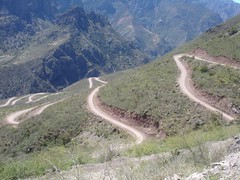
If you look very closely at this photo you may see the foot paths and used by the Tarahumara (Raramuri) Indians to access the resources of this canyon and the way the people of this region travel to and from the outback.
We hitched a ride down to the bottom with four Canadians driving this dusty, teeth rattling, back jarring road. It took around 5 hours to drive this 65k (40 mile) road. Around every corner was a new photo opportunity. We also hitched back with a kind couple from Mexico City who had hired a guide to bring them down and back up to creel.
(Thank you folks for the ride and the time we had to share).
The road was only really wide enough for one car so if another vehicle came around the corner, one of the drivers had to back up or down the road to a spot wide enough for both to squeeze by.
Batopilas aquaduct
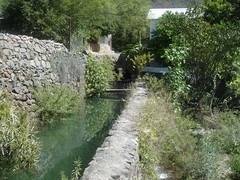
Along the way she swam in the Rio Batopilas river, panned for silver, meet a goat herder, and also a guide on a horse returning from a 3 day trip to Urique and back to Batopolis. Most stunning were the flowering cactus and trees found in this deep desert canyon.
View La Bufa in the bottom of Copper Canyon, Mexico
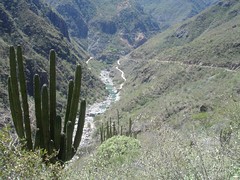
Here is a photo overlooking the road to La Bufa and eventually to Batopilas.
This area is the home to the famous Indians Traumara (Raramuri). One of the oldest people in North America, migrated to this area to avoid conflict with the Spanish Missionary. This shy group of people who live a subsistence life style can be recognized by their unique clothing and dark skin. The men wear a white loincloth, sandals, and an array of shirts and the women wear colorful layered blouses and skirts and large scarfs of multi designs.
It does appear the Traumara (Raramuri) have huge struggles with health, farming in this harsh climate though they have some of the most efficient farming methods known, and preservation of a culture that is in conflict with a monetary society.
The death rate for women giving birth is one in ten. The death rate amoungst children under 5 is 50 percent. Poverty amongst these people in this area is so rampant it touches everyone. read more here... lee mas aquí... »
Exhacienda Minera near Batopilas
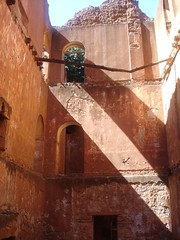
Even today there are mining activities in the far mountains in Copper Canyon where new roads have been built giving people access to areas of this region where before only foot access was possible.
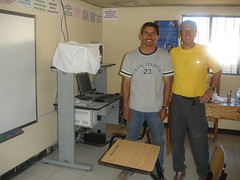
Candelario Viniegra Chavez in his 6th grade classroom
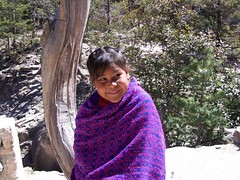
Tarahumara girl at Curarare falls
We're now in Copper Canyon, the land of the Tarahumara. In Mexico they call this the Sierra Tarahumara (the Tarahumara mountains). [We tend to agree with the Mexicans about the perspective - it's *mountains*. ]
The Tarahumara people who have lived here for centuries are a fascinating people. The women are brightly dressed and the men have a special skirt that seems specially adapted to running, for which they are world famous.
The Tarahumara speak Spanish generally only as a second language (if at all) and live dispersed all over this region. They might live many, many hours on a winding mountain path from the nearest town or road. They seem quite shy, but this little girl gave Nancy a very pretty smile.
Efrén and his family in Humirá
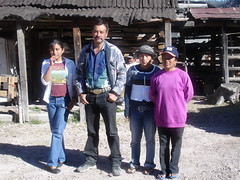
A couple of nights ago we stayed in Humirá with some of the most impressive people we've met on the trip. Humirá is right before the really big climb out of the second canyon out of Creel, and we got there about 4:30, knowing we had about 25K and more than 2000 feet of climbing ahead of us. We stopped to chat with a farmer out working with his whole family on clearing trimmed wood from their apple orchard. When we decided to bail for the night we rode back and asked them if we could stay at their place. That's how we met Efrén. We helped with the wood-hauling until dusk, and then set up the tent. They fed us beautiful blue corn tortillas in the evening (we got to see the whole process). read more here... lee mas aquí... »
Luis Alfonso Valencia - Bicycle commuter near Navojoa
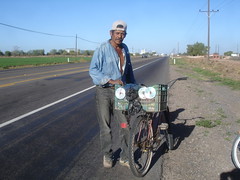
Do you notice the wonderful reflectors he has for safety on the back of the bike? They're discarded CDs. So why do we use anything else? We're going to try to get some for our bikes.
In the flat agricultural region from Navojoa to the sea we saw many, many cyclists, mostly on bikes like Luís's. In one small city we saw three bike shops in one small region of the downtown. And we've seen bike shops in several towns we've been in. We're just hoping they have some of the parts we need when the time comes.
