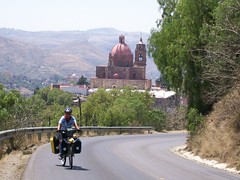
Cholula Street Work Archaeology
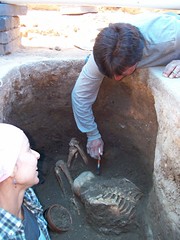
So there we were walking down the street in Cholula after visiting the 2000-year-old pyramid. They're completely redoing all their streets so everything is completely torn up. But we noticed a different kind of pit in the middle of the street, with a woman working in it, which seemed strange. It turns out that all this street work is supervised by archaeologists, and they had discovered a whole house and a burial site underneath it. They invited us to come down into the pit and see their find - a grave with ceramic offerings from about 500 A.D., the "Classic" period of Mesoamerican cultures. So we got educated about real-life archeology right in the middle of the torn-up streets of Cholula!
(Cholula was founded about 620 B.C. and was a major center from about 100 A.D. clear up until the Conquest in the 16th century.)
Where we are - Early May, 2007
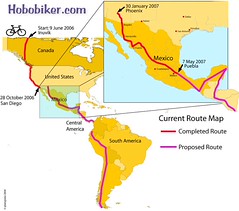
We're in Cholula, Puebla, very close to the city of Puebla. Cholula is the city from which Cortes the Conquistador used as a launching point for his attack on the Aztecs at Tenochtitlan (today's Mexico City). He went over the very pass we did, now known as the Paso de Cortes.
Riding Between the Volcanoes
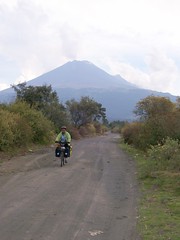
Popo (actually Popocatepetl) and Ixta (Iztaccíhuatl) are two of the three highest mountains in Mexico, at over 17,800 feet (5,400) meters, and the saddle between them is called the Paso de Cortes, and it's at 12,000 feet (3650 meters). Cortes came over this pass from Cholula (where we are tonight) to attack the Aztecs at Tenochtitlan (today's Mexico City). It's a direct route over the rim of the Valley of Mexico, but the 4,000 foot climb around a smoking volcano was a little threatening to us!
Mexico City: Culture, Tacos, Demonstrations
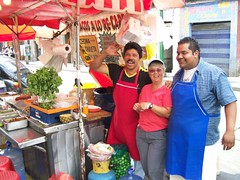
We spent a week visiting incredible Mexico City, probably the world's largest city with close to 20 million inhabitants. Despite the warnings of everyone (as is common for any large city) we didn't have any trouble. No trouble in the streets, no trouble in the subway, no trouble on the buses. We felt comfortable walking and using the subway returning home the last night even though it was after 11pm.
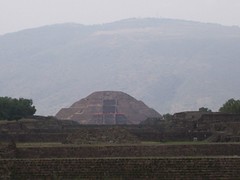
Teotihuacan, Toltecs, and Aztecs
Queretaro and the Ciclonautas
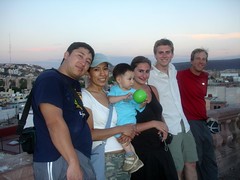
In Querétaro we visited with Dulce and Andrei, whom we'd heard about from our Dutch cycle-touring friends Dick and Els. We had a delightful evening and day with them enjoying the area and hearing their stories. They're now temporarily retired from bike touring - and have a delightful 18-month-old named Emiliano and are living the life of a young family. From 1998 to 2001, with nearly no resources, they traveled from Querétaro south through Mexico, Central America, and South America all the way to our destination, Ushuaia. Unlike us, they had scarce resources and had to earn money along the way. Click here to read their whole story in both English and Spanish and see their pictures.
Queretaro was yet another delightful, interesting, old city, with cultural events and music on every corner, and a 500-year-old church on every block. We spent a couple of days taking it in and hearing Andrei and Dulce's stories. And Andrei took us (along with new Belgian friends Lorenzo and Sarah) on a tour of the city.
Dolores Hidalgo, San Miguel, Queretaro
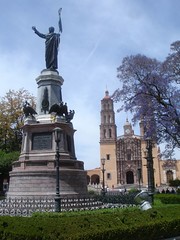
San Miguel has the most active interesting plaza. I sat in the plaza and painted well into the night. While drawing I listened to various musical bands serenading the people hanging around the plaza. San Miguel has a large gringo population that has retired to this area and has influenced the culture of the area. As a result there is a huge library with wide selection of books in multiple languages, a very active art community and more old women beggars then any place else.
Guanajuato and the Valenciana Mine