rfay's blog
Beautiful Riding and The Rich Culture of the Peruvian Andes


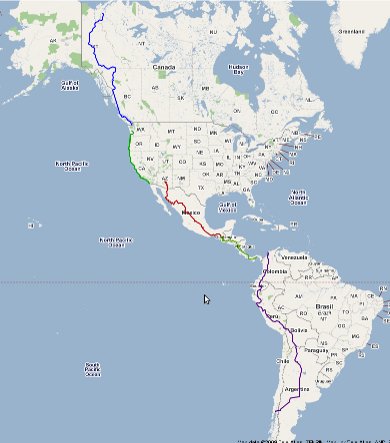
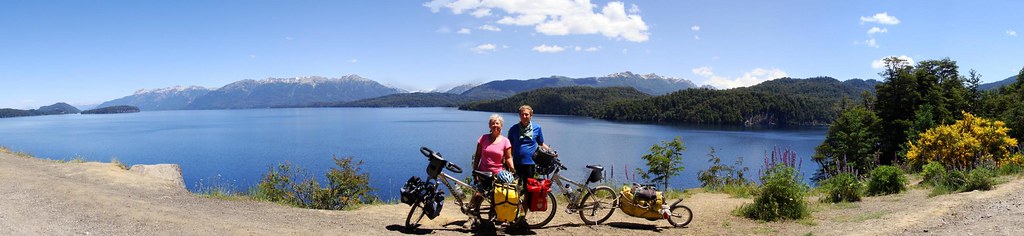
We've just had the delight of riding right up into the Andes, over the highest pass of our trip, and over hundreds of kilometers of both paved and dirt road. It has to be some of the best bike touring we've ever done. And some parts of it were probably as hard as we've ever done.
In Huaraz, in the Cordillera Blanca, we looked out of our hotel window at the amazing peaks of the tallest mountain range outside the Himalayas. Huaraz is at about 3000 meters, or 10,000 feet. But from there we began to climb gradually to a pass at 4300 meters, then down a bit, then up to the biggest pass of the trip, at 4700 meters (15,400 feet). It was all incredibly beautiful.
But the best part all along the way was the people we met. There were shy families along the way, tending their sheep while knitting or spinning wool into yarn. One woman let Nancy hold her most prized lamb. We ran into celebrations in three different villages. They roped us into the dancing and the eating and the drinking. It was a delight. We stayed the night camped out with a Spaniard who is "getting away from it all" with a flourish - he and a friend showed Nancy how to pan for gold - and she found a little flake of gold in the Rio Maranon! Now she's rich and can afford the rest of the trip.
read more here... »Money Management On The Road
Lots of people ask us how we get money while travelling, and whether we carry a lot of cash, etc. Here's an attempt to answer your questions.
Money is obviously a big issue. You want to have enough, but not so much that you might lose it all at once.
These days it's just tremendously easy to get money from ATMs. The only exception to this that I know of is Cuba, and that's a whole different story. But everywhere we've been we're just a few days from an ATM. There are times the ATM doesn't work or won't dispense the amount of money we want, but the ATM has completely put away the use of travellers' checks (a waste of time and money) and the need to carry large amounts of dollars. (FYI: There are actually a number of machines in Latin America where you can withdraw dollars in addition to the local currency.)
Some tips:
- Use a debit card. It costs LOTS of fees to do a cash advance against a credit card.
- Find out from your bank how much it will cost to use your card at an ATM in Latin America. Some banks charge 2% of the advance and perhaps an additional transaction fee. Our bank (Fidelity) charges nothing. (The ATMS/Banks themselves sometimes charge a fee, but usually not. Sometimes there's a US$1.00 fee tacked on the statement. Sometimes there's a fee added at the ATM. Often there's no charge.)
read more here... »
Gringo is not a bad word, and other misunderstandings

Everywhere we go in Peru the children cry out "Gringo!" It has happened in lots of countries, but they're SO enthusiastic about it here. Some cyclists misunderstand this cultural phenomenon and think that "gringo" has a negative context (or only applies to North Americans). It's just not true. Gringo is just a regular descriptive term, and everywhere we've been it just describes people who talk funny, wear funny clothes, have a funny walk, and probably have money. That even includes people from Chile, and can include kids from the city who dress like gringos.
Some people have heard the story that "gringo" was something said in Mexico during the various US invasions, and it referred to the green uniforms of the invading US troops, and they were saying "Green Go Home" or something. Well, it might be true (nobody knows) but is has nothing to do with what "gringo" means today. Gringo just refers to any north-American, European, Japanese, or most any foreigner who looks or talks funny. It's not an insult. Of course, like any descriptive term it could be used as an insult.
read more here... »Bike Maintenance In Latin America
People sometimes ask us what kind of bike we recommend, and how we manage bike maintenance. Here are some thoughts.
Ride a bike that's maintainable. In Latin America, that means a 26" mountain-bike style bike with standard components (V-Brakes or cantilever brakes, not disk brakes). You can buy 26" tires and tubes in even a small town, and you can find a mechanic who will have at least some tools for working on your bike. In a medium-sized town, you can get a rim and maybe spokes. If you have a 700cm wheel, you may have to send away to the nearest capital city and wait for a few days to get some of these things. Some people with difficult-to-obtain parts have spent lots of money on international shipping (and then on customs duties) and have waited ages to get going again when they've had a failure.
Ride a bike that's strong. It's better to be heavy than fragile. Get 36-spoke wheels (we're committed to this after a long failure of a 32-spoke back wheel in Canada. We haven't had a broken spoke since we switched to 36 spoke wheels). Get straight-gauge, strong spokes.
Carry a few spare parts. You can't carry everything. We always have tubes and patch kits, some spokes and the tools to replace them. Many people carry a spare tire. We don't, at least until now.
read more here... »Camping Versus Hotels in Latin America

When other cyclists told us we would probably spend a lot of nights in hotels in Latin America, we kind of scoffed at them. As seasoned bike tourists, having camped all over the US and Canada, we figured we'd be camping more than most.
But we have been staying more than 80% of the time in hotels in Latin America (although that number is declining as we get farther south). People ask about this, so we thought we'd tell you why.
Camping in Latin America is different from camping in the US and Canada. There are no (or almost no) "official" campgrounds. It's really rare to see anything like that, and when you do, it's often more expensive than a hotel. And there is almost no "unclaimed" land, like in the western US or Canada. In the US and Canada, if you see a quiet place, you can just set your tent up there (if you're discreet) and nobody will ever know or bother you. In Latin America, almost everything is "owned". One time we set up discreetly behind a horse barn in a Mexican pasture right at dusk. Since we had run out of options, we just set up. We were immediately discovered. Some kids came and checked on us right away. Nobody bothered us, but we were not succeeding at hiding out.
read more here... »Our highest point yet: 15,400 feet (4700 meters)

Today we crossed the highest point of our journey so far, and perhaps the highest of the trip. After climbing back up into the Andes (the Cordillera Blanca) for more than a week, we crossed over 15,400 foot (4700 meter) Abra Yana Shalla. We had been working our way up to this, climbing no more than 1000 meters per day as we got into the really high places. Nancy really felt the altitude in a number of ways, so we were trying to be as careful as possible. But we made the last push this morning up into the barren peaks. We saw lots of beautiful scenery in the last few days and will try to get the pictures uploaded within a few days.
Health, Healthcare, Health Insurance, and Vaccinations for the big ride
People often ask us about health-related issues, so here are some answers.
Health Insurance: Since we are from the US, with an immensely expensive and burdensome healthcare system, we felt that we had to carry health insurance that would cover us there. Although we might be able to cover expenses for most types of events in the other countries of our journey, a single week in a hospital in the US can easily bankrupt anyone. So we carry normal (expensive) major medical, high deductible ($10,000) health insurance that would cover us if we had to go limping home for a major chronic illness or something. But that insurance doesn't cover us outside the US, so if we had a serious accident or something, we could end up without coverage. So we also bought health insurance that covers us outside the US (cheaper by far). Our monthly expenses for health insurance are probably the biggest expense of the trip.
Note that "Trip insurance" is not worth much for a trip of this size, since it is not renewable and typically has pretty serious limitations. It's oriented to people going on vacation, not to people living abroad. What we needed (and most travellers will need) is the type of insurance that expatriates buy. The folks at Global Insurance Net make a specialty of this type of insurance, and we were pleased with their expertise and service.
read more here... »Randy switches to a BOB trailer... Advantages and Disadvantages

When we came back to Peru I started riding with a Ibex BOB trailer trailer again instead of using panniers as I have for the last few years. It was kind of a return to my roots, since I used a BOB for our first several rides in 2001-2005. So far, I'm happy to be pulling my old friend Bob again. It feels good on the bike.
You may not know it, but since the BOB was introduced, US touring cyclists have often raged at each other about its advantages and disadvantages. As one who has used both the pannier system (front and back racks with saddlebags attached to them) and the BOB, a single-wheeled bike trailer, I thought I could weigh in on advantages and disadvantages.
- I think when you ride with the BOB it's more like riding a bike and less like driving a truck, which is how I feel when riding with panniers.
- The BOB is a bit easier on the bike, since there's one more wheel to spread out the load. The frame of the bike gets almost no strain (and it can get quite a bit going over bumps with the panniers). The rear axle still gets about half the load, but the frame itself gets almost nothing.
- My kickstand doesn't work any more! In general, it's just harder to manage the bike+bob configuration when you're off the bike. I think it's easier to manage when you're riding, but harder when you're off. For example, you can't easily back up (just like with a car and a trailer.)
read more here... »
Cyclists before us at the Casa de Ciclistas

People often ask us "Has anyone ever done this before?" or "Are you setting a new Guinness Record?". The answer, of course, is an authoritative NO! We know this, of course, but stopping at the Casa de Ciclistas in Trujillo and looking through the logs makes us really feel humble. We were the 998th entry over 24 years. Plenty of people have been through here! There are slow people and fast, many rides as long as ours, but many much longer. Here are a few links and a few details about some of the folks who have signed their names in the logs at Trujillo.
- Hans Stuecke
- Hans has been bike touring for 46 years, and has visited at least 193 countries. He really HAS set a Guinness record. I don't think we're going to touch his record anytime soon!
- Dominic Gill
- Dominic started his ride about the same time as we did, and we actually met him for a few moments in Whitehorse, Yukon Territory. But Dominic just finished riding a tandem (most of the time by himself, alone) with gear for himself and a guest, all the way from Alaska to Patagonia. His gear weight was incredible, but his idea was "Take a Seat". He invited anybody who wanted to to come along for a ride for as long as they wanted. He had incredible experiences. read more here... »
Lucho and the Casa de Ciclistas in Trujillo, Peru

When we came down from the mountains of Peru to the coast we stayed at the fabled Casa de Ciclistas (House of Cyclists) in Trujillo, Peru. Lucho Ramirez started offering his simple house to passing touring cyclists clear back in 1984, and is on the edge of crossing the one thousand mark. One thousand groups of cyclists have signed his journal and stayed there over almost 25 years! One cyclist stayed a year! Many stay far longer than they expect to, often for a week or more. It's a delight to browse through the journals and see famous cyclists that we've either met or heard of who passed this way. Our friends Dick and Els, from Holland, signed the book about 5 years ago. Our friend Andrew signed it just a month or so ago. Our friends Pat and Cat also passed through about 3 years ago.
Many of you have asked us if we're setting some kind of a record or something, and the answer is no, we're really slow, and lots and lots of people have gone farther. Although not all the cyclists who have stopped at Lucho's house were doing rides as big as ours, many were doing rides much bigger. One fellow, Hans Stuecke, has been cycling for 46 years!
read more here... »